Techniques BABOK Guide v3, 10.16
Decision Analysis
In short Decision analysis takes one important, complex decision with a limited number of options and evaluates each option against explicit criteria and uncertainties. You get a recommendation that people can inspect, challenge and re-run when assumptions change, instead of a choice made on gut feeling.
Based on: IIBA, BABOK® Guide v3, technique 10.16 “Decision Analysis”; Watermark Learning, BABOK v3 Study Tables (2016), technique 10.16; business analysis training materials (decision tree exercise).
On this page
What it is#
The BABOK Guide describes decision analysis as a way to model the important aspects of a complex decision so that the value of each alternative can be judged objectively and uncertainty reduced. Most approaches rely on logical models and simple mathematics rather than intuition.
Its components are:
- The decision to be made, stated as a problem or question.
- The decision maker: who actually chooses.
- Alternatives: the options, including “do nothing”.
- Decision criteria: what makes an option better or worse.
Typical tools:
- Decision matrix — options in rows, criteria in columns, with scores. A weighted matrix multiplies each score by the criterion’s importance.
- Decision tree — decision nodes (your choices), chance nodes (uncertain events with probabilities) and end nodes (outcomes with values). You calculate the expected value of each choice.
- Trade-offs — remove dominated alternatives (worse than or equal to another option on every criterion), and put different objectives on a common scale so they can be compared.
The BABOK Guide outlines the process as: define the problem, define the alternatives, evaluate them, choose one, and implement the choice.
Do not confuse this with Decision Modelling. Decision analysis supports a mostly one-off choice between a few options; decision modelling captures the logic of decisions that repeat every day.
When to use it#
The BABOK Guide lists it widely: in prioritizing, assessing changes to and approving requirements; in defining the future state, assessing risks and defining the change strategy; in Analyze Potential Value and Recommend Solution; and across Solution Evaluation. Use it when:
- the decision is significant and hard to reverse;
- there are several plausible options and real uncertainty;
- financial and non-financial criteria must be weighed together;
- you need to show stakeholders, or auditors, how the choice was made.
Do not use the full technique for cheap, reversible decisions, or when the information will not arrive in time. The BABOK Guide also notes the risk of analysis paralysis, that decision makers must be honest about the model’s assumptions, and that some models need specialist skills. Timebox the analysis to match the stakes.
How to do it#
- Frame the decision. Write one question, name the decision maker, and agree the deadline.
- List alternatives, always including “do nothing” as a baseline. Use techniques for generating alternatives if the list feels thin.
- Agree criteria and weights with the decision maker before scoring, so scores cannot be tuned to a favorite.
- Remove dominated alternatives.
- Score or model each remaining option: a weighted matrix for multi-criteria choices, a decision tree where outcomes depend on uncertain events.
- Test sensitivity. Change the weights, probabilities and values within reasonable ranges. If the ranking flips easily, say so.
- Recommend, stating the assumptions, the runner-up and what would change the answer.
- Record the decision and revisit it if key assumptions turn out wrong.
Example#
The Workshop, a fictional chain of 12 bike-repair workshops, must choose how to offer online booking: (A) subscribe to an off-the-shelf booking service, (B) have the outside development team build a custom system, or (C) do nothing. All figures are invented.
Weighted matrix (scores 1–5, 5 is best; weights sum to 100):
| Criterion | Weight | A: Off-the-shelf | B: Custom build | C: Do nothing |
|---|---|---|---|---|
| Benefit to customers | 30 | 4 | 5 | 1 |
| Three-year cost | 25 | 4 | 2 | 5 |
| Time to launch | 20 | 5 | 2 | 5 |
| Fit with workshop process | 15 | 3 | 5 | 3 |
| Delivery risk | 10 | 4 | 2 | 5 |
| Weighted total | 405 | 335 | 350 |
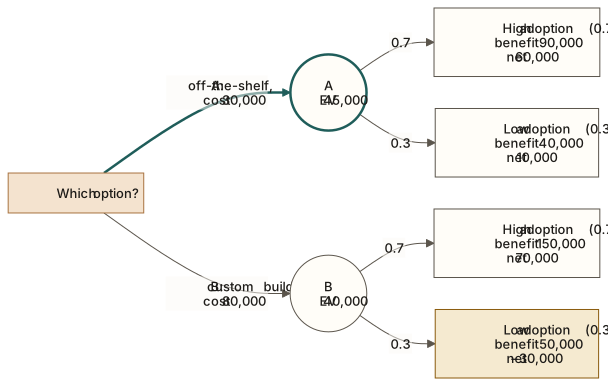
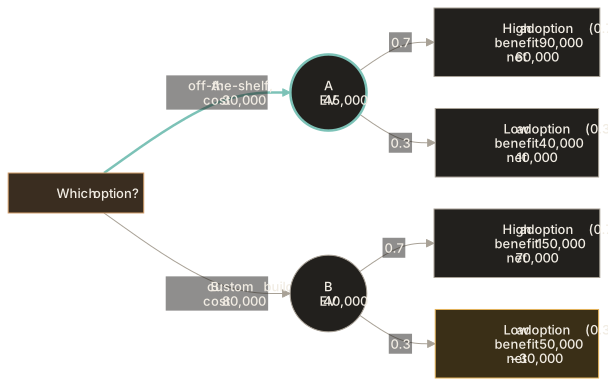
Decision tree for A and B, where the uncertain event is customer adoption (probability of high adoption estimated at 0.7):
- Recommended option (A)
View as text
A: cost 30,000  -> high adoption (0.7): benefit 90,000
                -> low adoption  (0.3): benefit 40,000
   EV = 0.7 x 90,000 + 0.3 x 40,000 - 30,000 = 45,000

B: cost 80,000  -> high adoption (0.7): benefit 150,000
                -> low adoption  (0.3): benefit 50,000
   EV = 0.7 x 150,000 + 0.3 x 50,000 - 80,000 = 40,000
Both tools favor A. The tree also shows the downside: in the low-adoption case A still nets 10,000, while B loses 30,000. The analyst recommends A, notes that B would win only if the probability of high adoption were above 0.8, and flags that “do nothing” outranks B in the matrix, which tells the owner that a custom build needs a stronger case.
The training materials practice the same expected-value logic on a product-choice exercise in which a certification outcome changes the payoffs, a reminder that a tree must be recalculated whenever new information changes a probability.
Common mistakes#
- Choosing first, analyzing later → fix criteria and weights before scoring.
- Leaving out “do nothing” → always include the baseline.
- Treating 1–5 scores as precise measurements → they are ordinal judgments; see measurement scales and present totals as structured opinion.
- Double-counting (for example, “cost” and “affordability” as separate criteria) → make criteria independent.
- Made-up probabilities presented as facts → state the source of each estimate and test a range.
- No sensitivity check → show which assumption would change the answer.
Template#
Decision: <one question>          Decision maker: <name>     Deadline: <date>

| Criterion | Weight | Option A | Option B | Do nothing |
|---|---|---|---|---|
| | | | | |
| Weighted total | | | | |

Key assumptions: ...
Sensitivity: the ranking changes if ...
Recommendation and runner-up: ...
Sources and further reading#
- IIBA. A Guide to the Business Analysis Body of Knowledge (BABOK® Guide), version 3. International Institute of Business Analysis, 2015, technique 10.16 “Decision Analysis”.
- Watermark Learning. BABOK v3 Study Tables. 2016 (study aid for the BABOK Guide), technique 10.16.
- Business analysis training materials (Strategy Analysis module: decision tree exercise with expected values).