Techniques BABOK Guide v3, 10.29
Mind Mapping
In short A mind map puts one topic in the center and lets ideas branch out from it in all directions. It is a fast, informal way to explore a problem, collect ideas in a group, or structure what you have learned before you turn it into a formal model.
Based on: IIBA, BABOK® Guide v3, technique 10.29 “Mind Mapping”; business analysis training materials (module on requirements analysis and design definition).
On this page
What it is#
A mind map is a non-linear diagram for capturing thoughts, ideas, and information. Instead of a list read from top to bottom, ideas radiate from a center, which resembles how people actually associate one idea with another.
The building blocks, as presented in the BABOK Guide and the training materials:
- Main topic — the subject of the map, placed in the center.
- Topics — the first ring of ideas, connected directly to the main topic. Keywords describe the connections.
- Subtopics — ideas that develop a topic further.
- Branches — the lines that connect topics and subtopics. A branch can carry a keyword that names the relationship.
- Color — used to group related ideas or to show priority.
- Images — icons or sketches for ideas that are hard to express in words.
There is no standard notation. A map can be drawn by one person or built by a group, on paper, a whiteboard, or in software.
When to use it#
- Exploring a problem or scope early on, when you do not yet know what the parts are.
- Generating options. The training materials place mind mapping among the techniques for defining design options in Requirements Analysis and Design Definition.
- Structuring raw information from interviews, observation, or documents into themes.
- Preparing an interview guide or a workshop agenda.
- Presenting a complex topic at a glance.
The training materials list its strengths: it supports collaboration and the discussion of complex ideas, helps decision-making, encourages creativity, and works well in presentations.
When to use something else. The same materials point out the flip side: because there is no formal notation, a mind map is weak as a way to pass information on, and the result may make little sense to anyone who did not help create it. When you need a precise, shareable artifact, convert the map into a formal model: a functional decomposition for complete, non-overlapping breakdowns, a concept model for business terms and their relationships, or a process model for sequences of work.
How to do it#
- Write the main topic in the center as a short phrase or question, for example “Repair-status notifications”.
- Add the main branches. Aim for four to seven distinct themes. Use single words or short phrases.
- Expand into subtopics. One idea per branch. Keep going until the ideas get too detailed to be useful at this stage.
- Label relationships with a keyword on the branch when the link is not obvious.
- Use color and icons with intent. Decide what each color means (for example, red = needs a decision) and write a small legend.
- In a group, one person draws while participants call out ideas, or everyone adds directly in a shared tool. Capture first and judge later, as in brainstorming.
- Tidy up. Merge duplicates, move misplaced branches, and mark gaps and open questions.
- Convert the result. Turn the map into the next artifact: a list of requirement topics, interview questions, a decomposition, backlog epics, or entries in the item log.
Example#
The Workshop is a fictional chain of 12 bike-repair workshops. In a short session with the owner, two workshop managers, and a front-desk employee, the analyst maps repair-status notifications. The map looks like this:
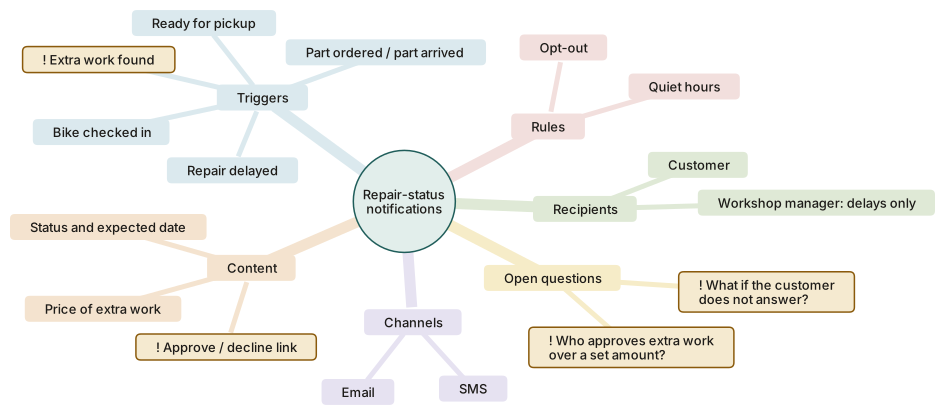
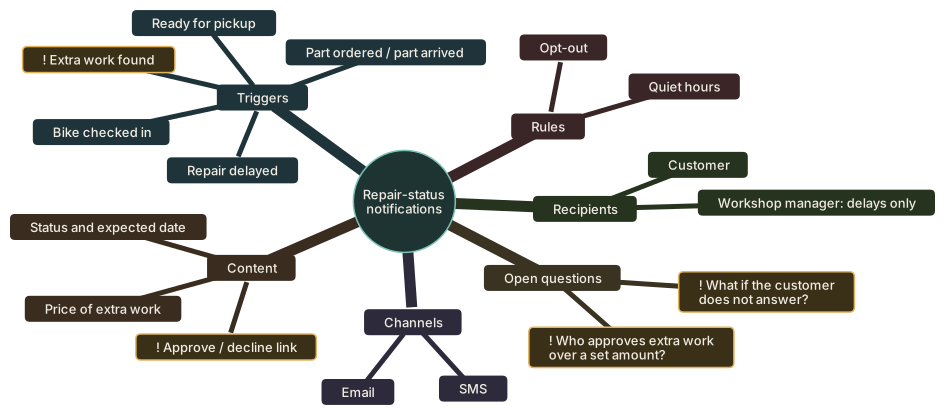
- Needs a decision (marked "!")
View as text
Repair-status notifications
- Triggers
  - Bike checked in
  - Extra work found  [red: needs decision]
  - Part ordered / part arrived
  - Repair delayed
  - Ready for pickup
- Recipients
  - Customer
  - Workshop manager (delays only)
- Channels
  - SMS
  - Email
- Content
  - Status and expected date
  - Price of extra work
  - Approve / decline link  [red]
- Rules
  - Quiet hours
  - Opt-out
- Open questions
  - Who approves extra work over a set amount?  [red]
  - What if the customer does not answer?  [red]
Building the map took twenty minutes and surfaced a whole theme nobody had raised in interviews: approving extra work. After the session, the analyst logs the red items as open questions, turns “Triggers” into a list of status events for the state model, and uses “Rules” as a starting point for business rules.
Common mistakes#
- Writing sentences on branches → use keywords; detail belongs in later artifacts.
- One giant map → when a branch grows deep, give it its own map.
- Treating the map as a specification → convert it into formal models and requirements.
- Sharing it cold with people who were not in the room → add a legend and a short explanation, or walk them through it.
- Judging ideas while capturing them → separate generating ideas from evaluating them.
- One person controls the pen → rotate, or let participants add their own branches.
- Colors without meaning → define a legend, or do not use color.
Template#
**Main topic:** <phrase or question>
**Date / participants:** <...>
**Legend:** red = needs decision; green = agreed; ? = open question

- <Main topic>
  - <Topic 1>
    - <Subtopic>
    - <Subtopic>
  - <Topic 2>
    - <Subtopic>
  - Open questions
    - <question>  → item log ID

**Next artifact:** <requirements list / decomposition / interview guide / backlog>
Checklist#
- The main topic is clear and phrased as a theme or a question
- Main branches are distinct themes, not overlapping
- One keyword or short phrase per branch
- Colors and icons have a legend
- Open questions are flagged and logged
- The map has been converted into a follow-up artifact
Sources and further reading#
- IIBA. A Guide to the Business Analysis Body of Knowledge (BABOK® Guide), version 3. International Institute of Business Analysis, 2015. Technique 10.29 “Mind Mapping”.
- Business analysis training materials (module on requirements analysis and design definition).