Techniques BABOK Guide v3, 10.22
Functional Decomposition
In short Functional decomposition breaks something large and complex, such as a process, a system, a product or a project outcome, into smaller parts, level by level, until each part is small enough to understand, estimate or assign. The parts at each level must add up to the whole.
Based on: IIBA, BABOK® Guide v3, technique 10.22 “Functional Decomposition”; Watermark Learning, BABOK v3 Study Tables (2016), technique 10.22.
On this page
What it is#
The BABOK Guide describes functional decomposition as splitting a complex, high-level item into smaller subsets for study or analysis, on the assumption that the subcomponents together describe the parent completely.
It organizes the technique around four elements:
- Objectives of the decomposition — why you are doing it: to understand, to scope, to estimate, to assign work, to measure.
- Subjects of decomposition — what you are breaking down. Common subjects are business outcomes, work to be done, processes, functions, business units, solution components, products and services, and decisions.
- Level of decomposition — how deep to go. Stop when each part is clear enough for the objective; deeper is not automatically better.
- Representation — how to show the result: a tree, an indented list, nested boxes, or a mind map.
Two rules keep a decomposition sound. Siblings should not overlap, and together they should cover everything their parent includes. Many practitioners know this as the MECE principle: mutually exclusive, collectively exhaustive.
When to use it#
The BABOK Guide applies the technique widely: in Plan Business Analysis Approach; in Trace Requirements and Maintain Requirements (breaking solution scope into components); across Strategy Analysis (understanding complex current and future states and the components of a change strategy); in Specify and Model Requirements; and in Define Requirements Architecture. Use it when:
- a problem or system is too big to discuss as one piece;
- you need to agree scope, assign work or estimate effort;
- you want to define metrics for each part of a process;
- you are structuring a requirements set so that nothing is missed.
Its weak points are worth knowing. Information may be missing or wrong at lower levels; exploring every branch can take a lot of time; and stakeholders may lack the depth of knowledge or the time to collaborate on a large breakdown. It also shows structure only, not sequence, timing or data flows: pair it with process modelling or data flow diagrams for those.
How to do it#
- State the objective. What question will the decomposition answer? This decides the subject and depth.
- Choose one subject and one basis for splitting. For example, split a process by stages or a system by functions. Mixing bases at the same level (some children by stage, others by department) causes overlaps.
- Name the top node precisely, with the boundary you have agreed.
- Break it into 3–7 children. Use verb–noun names for functions and processes (“Book repair”).
- Test each level. Overlaps: could a piece of work belong to two siblings? Gaps: is anything in the parent not covered by a child?
- Go deeper only where needed for the objective. Branches can stop at different depths.
- Number the nodes (1, 1.1, 1.1.1) so you can reference them in requirements, estimates and traceability.
- Review with stakeholders who know each branch, and keep the tree up to date as scope changes.
Example#
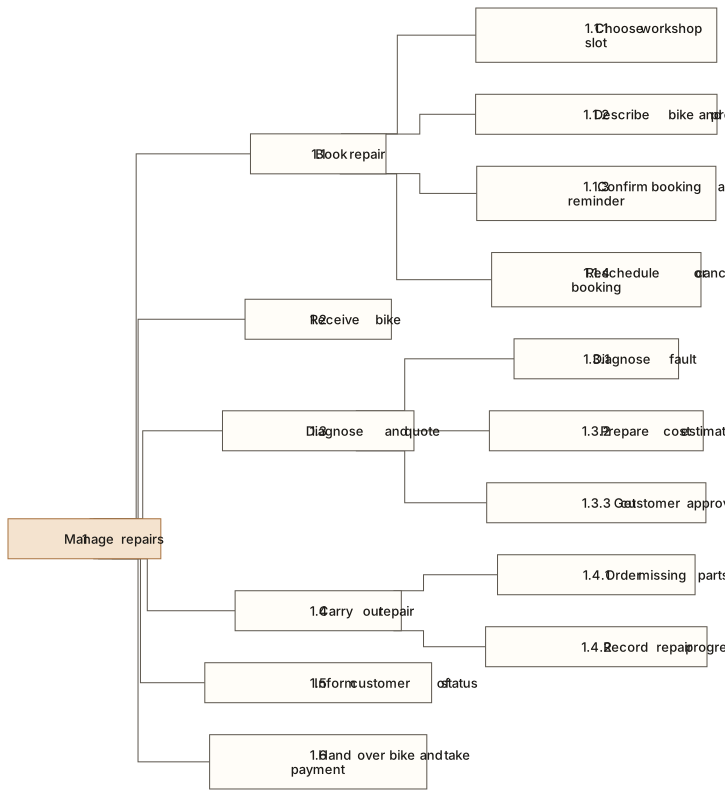
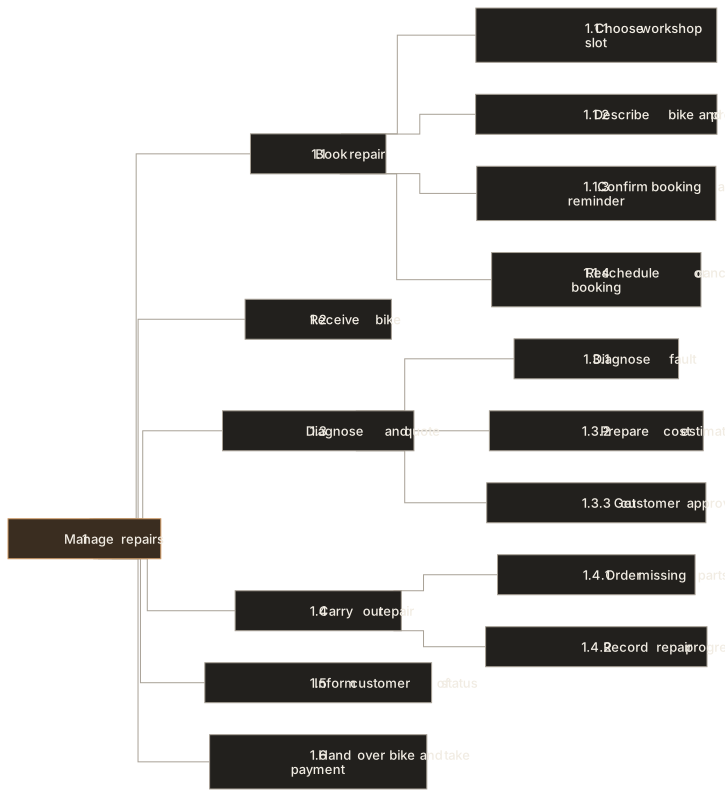
The Workshop (a fictional chain of bike-repair workshops) needs to agree the scope of its new booking and repair system. The analyst decomposes the function “Manage repairs”:
View as text
1  Manage repairs
   1.1  Book repair
        1.1.1  Choose workshop and time slot
        1.1.2  Describe bike and problem
        1.1.3  Confirm booking and send reminder
        1.1.4  Reschedule or cancel booking
   1.2  Receive bike
   1.3  Diagnose and quote
        1.3.1  Diagnose fault
        1.3.2  Prepare cost estimate
        1.3.3  Get customer approval
   1.4  Carry out repair
        1.4.1  Order missing parts
        1.4.2  Record repair progress
   1.5  Inform customer of status
   1.6  Hand over bike and take payment
Testing for gaps, the owner asks where warranty returns go. They do not fit anywhere, so the analyst adds “1.7 Handle warranty return”. Testing for overlap, the team notices that “1.5 Inform customer of status” and “1.1.3 Confirm booking and send reminder” both send messages; they agree that 1.5 covers only messages after drop-off, and write that boundary into the node’s description.
The numbered tree then serves three purposes: the release plan (1.1 and 1.5 first), the estimate (each leaf estimated separately) and traceability (each requirement points to a leaf).
Common mistakes#
- Mixing bases for splitting at one level → choose one dimension per level (stages, functions or organizational units).
- Overlapping siblings → write a one-line boundary for each node and test real cases against it.
- Missing pieces → for each parent ask “What else happens here?” and check with the people who do the work.
- Going too deep everywhere → stop when a node is clear enough for the objective.
- Confusing structure with sequence → a decomposition tree is not a process flow; draw the flow separately.
- Letting the tree go stale → update it when scope changes, since estimates and traceability depend on it.
Checklist#
- The objective of the decomposition is stated.
- The top node has an agreed boundary.
- Each level uses a single basis for splitting.
- Siblings do not overlap and together cover their parent.
- Depth matches the objective.
- Nodes are named consistently and numbered.
- Stakeholders for each branch have reviewed it.
Sources and further reading#
- IIBA. A Guide to the Business Analysis Body of Knowledge (BABOK® Guide), version 3. International Institute of Business Analysis, 2015, technique 10.22 “Functional Decomposition”.
- Watermark Learning. BABOK v3 Study Tables. 2016 (study aid for the BABOK Guide), technique 10.22.